PRIMER
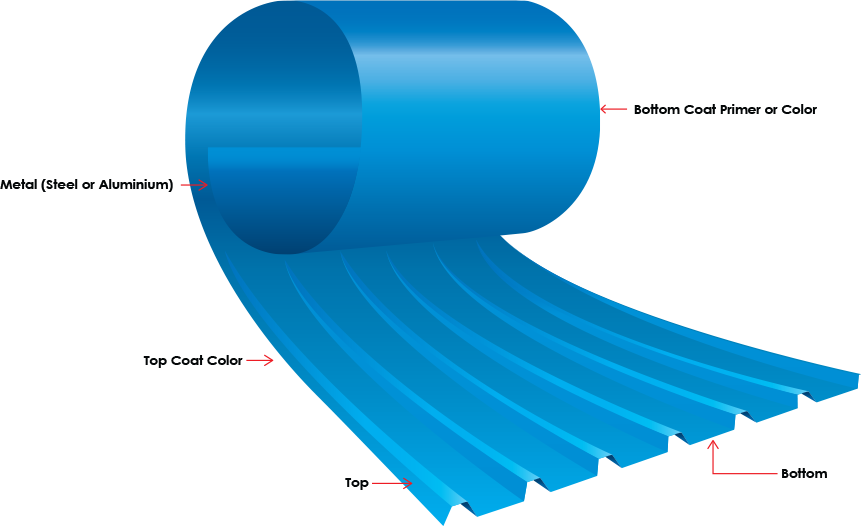
It is a specially formulated flexible light Grey backing cover with nominal thickness of 5 micron. The reverse side of profi le is normally coated with primer to provide adequate protection in dry internal environments.
POLYESTER
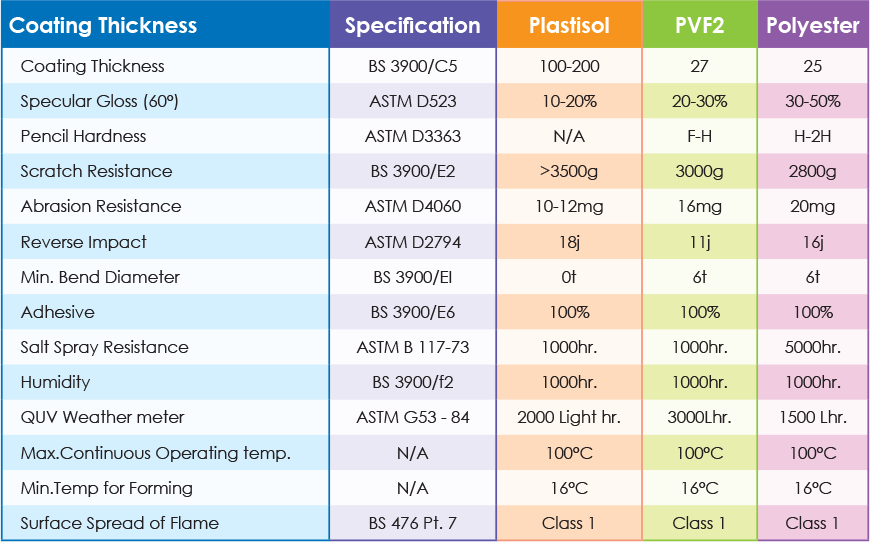
Polyester is a 25 microns coating combining economy with excellent fl exibility and temperature stability. Under normal environmental condition, Polyester coating is durable protection cover. With appropriate attention sheet lifetime may increase considerably.
ARS
Other fi nishes, such as ARS (Abrasive Resistance Surface) are also available, this type is used for cladding, guttering and general engineering purposes. It has good stain and dirt resistance, excellent mark resistance and color retention properties.
PVDF
Polyvinylidene Fluoride is 27 micron thick coating. It is suitable for worldwide roofi ng and cladding applications, PVF2 is an inert fluorine modified system based on Kynar 500 resin. The coating is resistance to solved attack and has continuous heat resistance ( 120°C).
Color retention is improved in all climatic conditions. PVF2 has excellent life expectancy on the weather side subjected to appropriate maintenance.
PLASTISOL
Plastisol is 100-200 microns (0.1mm-0.2mm) thick polyvinyl chloride coating (PVC) this coating exhibited an embossed leather grain fi nish. It is tough; withstand rough treatment in workshop, during transit, and on site. Plastisol is suitable for cold stores due to its excellent resistance to corrosion temperature and cleaning process.
HIGHLY REFLECTIVE ROOF COATING
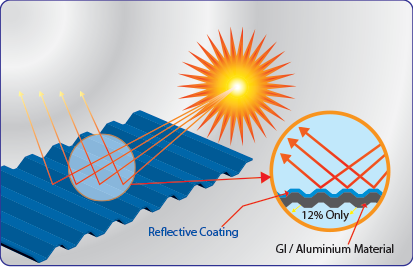
Highly reflective roofs can reduce the indoor temperature of buildings by 10 to 12 degrees Celsius, which lowers their cooling needs and thus results in cooling energy savings of approximately 10 to 20 percent on the fl oor under the roof. The thickness of the Insulation fill material (E.g. – Rockwool) can be reduced without compromising the thermal resistance of whole system.
Advantages :
- Reduce energy bills by decreasing air conditioning needs,
- Improve indoor thermal comfort for spaces that are not air conditioned,
- Decrease roof operating temperature, which may extend roof service life
Environmental Benefits
Reduce local air temperatures, which improves air quality and slows smog formation; Reduce power plant emissions, including carbon dioxide, sulfur dioxide, nitrous oxides, and mercury, by reducing cooling energy use in buildings; and Reduce heat trapped in the atmosphere by refl ecting more sunlight back into space, which can slow climate change.